INSTALLATIONS
> selection
“Mlenek prefers to combine the magic of a place and its design with history. The self-referential artwork alone doesn’t interest him.” - Dieter Ronte
Polestar Art Space
Artistic Intervention(with Kunsthaus Wiesinger, Vienna)
2023
“It started with a point and a universe opened up for me.” Accompanied by Ravel's "Bolero" and an introduction by Silvie Aigner of Parnass, Hannes Mlenek crafted an art installation spanning six meters at the Pole Star Art Space in the heart of Vienna's city center. This intervention occurred within the framework of the Art Austria 2023 Art Fair and received support from Kunsthaus Wiesinger, AT.

Photo © Polestar/Oscar Baumgartner
PROJEKT ARCHE - EINE ÜBERLEBENSSTRATEGIE
(PROJECT ARK - A SURVIVAL STRATEGY)Prateratelier, Vienna
2018 - ongoing
Since 2016, Hannes Mlenek has been working in the Praterateliers, a complex originally built for the 1873 World Exposition. The site’s spatial generosity continues to offer artists room for expansive experimentation. Mlenek’s multi-storey studio occupies the only remaining historical pavilion, functioning both as a display space for his monumental works and as a laboratory for the development of his installations. Among his recent projects is PROJEKT ARCHE – Eine Überlebensstrategie, a transdisciplinary initiative intended to heighten public awareness of this historically charged area. At its core stand two ten-metre-high “Gender Towers,” monumental structures that anchor the installation both physically and conceptually.
 Photo © Patrick Langwallner for Polestar, 2023


MEDUSA*EXPEDIT - MEDUSA*ODEON
Performances in cooperation with Bert Gstettner, Tanz*HotelVienna/New York, US
2015/16/17
In collaboration with performance artist and choreographer Bert Gstettner (Tanz*Hotel), Hannes Mlenek realized two stage projects, MEDUSA*EXPEDIT and MEDUSA*ODE, both inspired by Théodore Géricault’s The Raft of the Medusa. Echoing the painting’s torn sails, Mlenek dismantled and deconstructed his own works in real time. What began as the role of an observing commentator—sketching and painting in the background—transformed into a physical performance, as the artist moved above, beneath, and around his canvases, reaffirming his central theme: the human body.
SEISMOGRAMM DER ERREGUNG
(Seismogram of Excitation)Installation for the exhibition “Line & Shape”
Leopold Museum, Vienna
2014
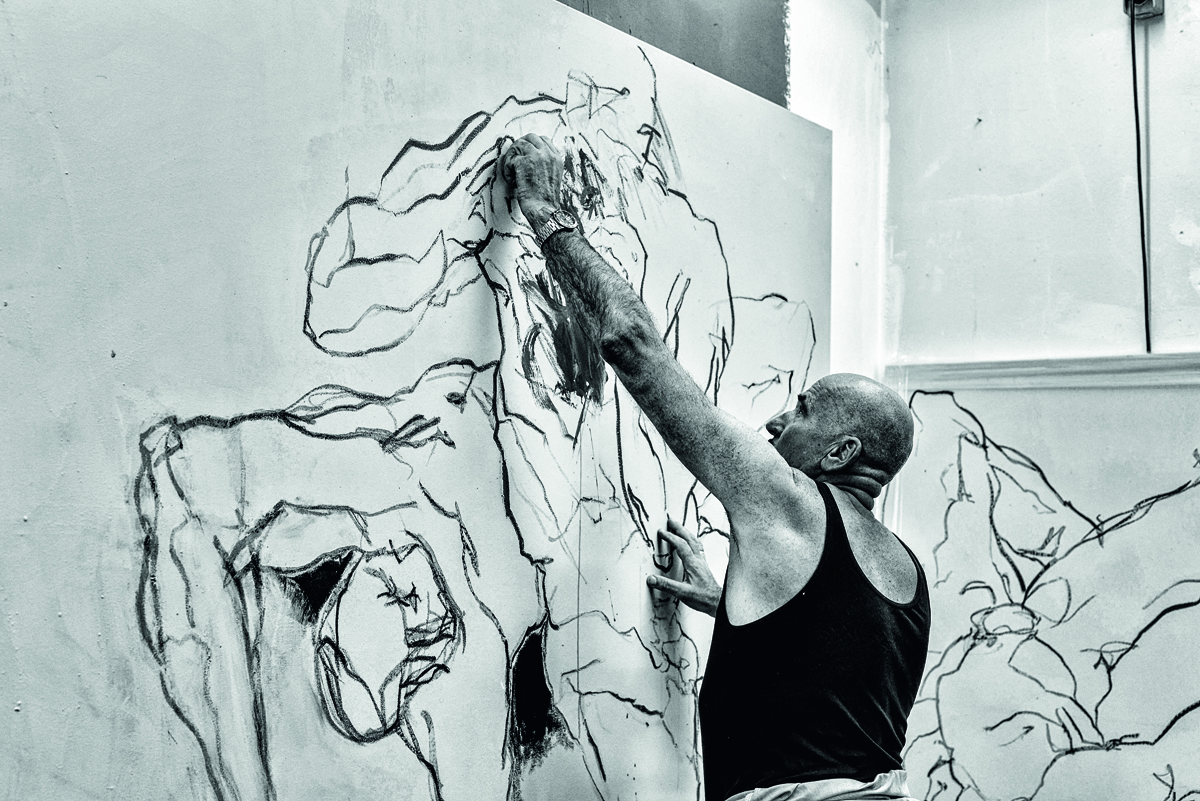
In 2014, the Leopold Museum exhibited works by Egon Schiele, Gustav Klimt, and Oskar Kokoschka in "Line & Shape". Abstract pieces by Oswald Oberhuber and Karl Anton Fleck paved the way for artist Hannes Mlenek's statement, who incorporated the exhibition walls into the site-specific intervention titled "Seismogram of Excitation". Mlenek focused on the motif of the nude, a recurring theme in the exhibition. The wall drawings were complemented by an object portraying a hand, measuring 4.30 x 2.10 meters. "The master's primary tool is not the pen or the chalk, but the hand," remarked the artist, echoing art historian Peter Weiermair's observation: "With Mlenek, the line doesn't end with the arm but where the thought transcends the line."


 Photos © Alexandra Mitsche | Leopold Museum, 2014
︎ youtube | Video Hannes Mlenek, Projects 2020-2018
WHERE THE THOUGHT LEAVES THE LINE
Art-in-Public-Space InstallationVotivkirche (Votive Church), Vienna
Feb - Dez 2013
In 2013, Mlenek involved the large billboard of Megaboard Soravia at Votivkirche, Vienna, into his art: 375 square metres of an expressive painting in black and white invited passersby to take notice of the location‘s uniqueness. The artist intented to create irritations in a place, which is not primarily intended for art. Elements of the painting (printed on vinyl mesh) suggested some figurative content, while the dynamics of the brushstroke dominated the scenery. “Where the thought leaves the line” presented as a graphic and highly minimalist work which could be seen throughout the entire year.


Photos © Robert Zahornicky
DER FALL PARSIFAL
Paulus Manker - “Wagnerdämmerung” (“Parsifal” | Paulus Manker - “Wagner’s Twilight”)
Installation in the scope of the theatre production,
Former Imperial & Royal Post Office, Vienna
2013
In “Wagnerdämmerung” Austrian impresario Paulus Manker staged his idea of Wagner’s life and oeuvre as an ironic and multi-sensory theater production. In addition, a contemporary art exhibition lead visitors into further dimensions. “Parsifal”, a site-specific installation, opened three levels of experience: The recipients were simultaneously beneath, on and in the artwork. Three art works on the ceiling and three paintings on the floor measured a total of 320 square metres. Wagner's oeuvre is of gigantic expressiveness - with “Parsifal” Mlenek engaged himself in a similar approach: In order to reflect the spaciousness of the work, not only in terms of form but also in terms of content, the body of a hermaphrodite was represented. The artwork was accompanied by Karlheinz Essl's Sound Environment ' »Parsifal Crystal« (2013).


Photos © Peter Kainz, Faksimilie Digitial
AIRFIELD - TRANSBOUNDARY
Land Art InstallationDobersberg, Lower Austria
2010
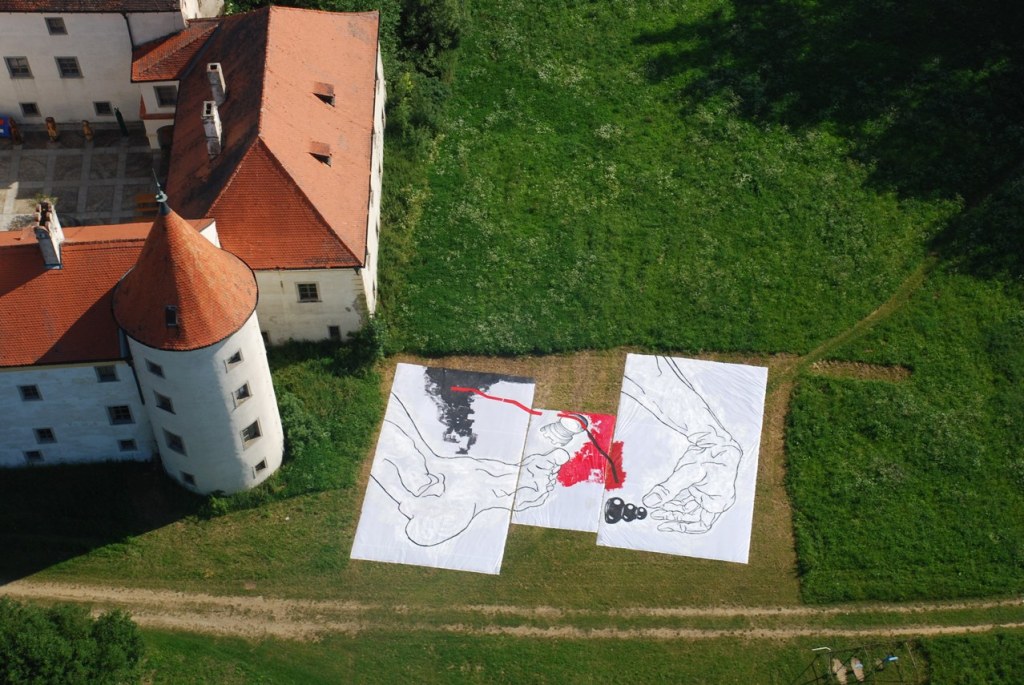
Referring to the Nasca scratching pictures in Peru, Hannes Mlenek shifted the way one can look at his paintings in “AIRFIELD-TRANSBOUNDARY”. Five art works on canvas and vinyl mesh - some with a size of over 700m2 - could only be grasped in their entirety from a bird's eye view. Visitors could take off in small-engine airplanes, crossing the border between Austria and the Czech Republic and between art and nature. “AIRFIELD-TRANSBOUNDARY” was initiated to create a space without borders by forcing a change of perspective through mere dimension.- Text (excerpt): Silvie Aigner / ArtMagazine 07/10/2010


Photos © Jürgen Moors
AIRFIELD - TRANSBOUNDARY
Project preparations & ExhibitionExpedithalle Brotfabrik, Vienna
2009
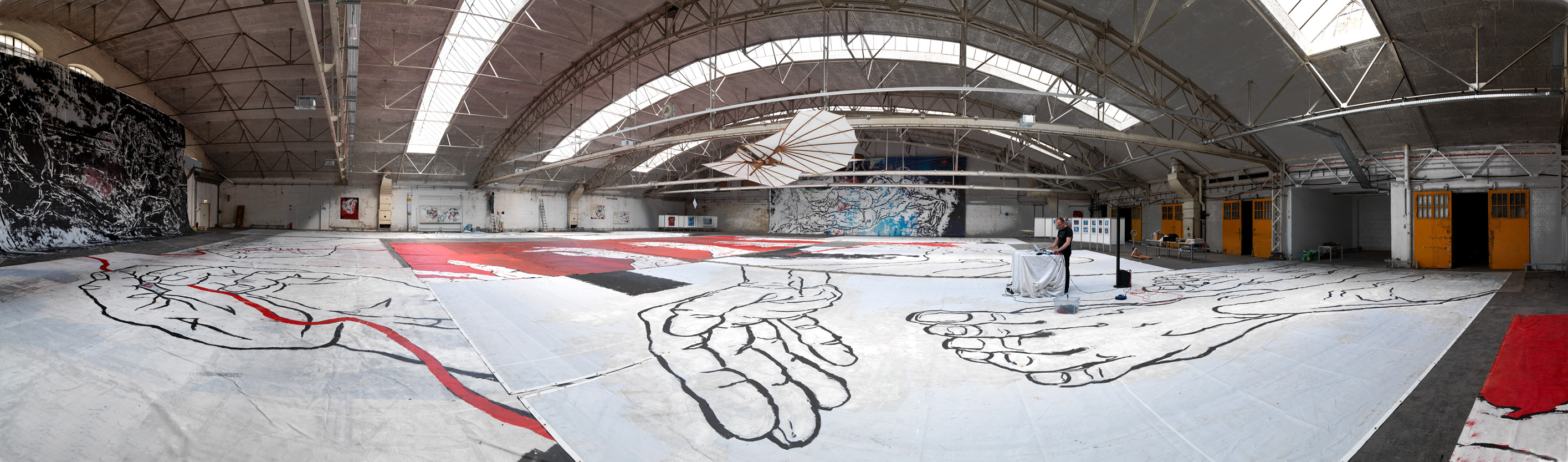
Project preperations, exhibition and book-presentation in the context of “AIRFIELD-TRANSBOUNDARY” at Vienna’s Brotfabrik, Expedithalle.


Photos © Gerald Plattner, 2009
NASCA, ALL OVER THE PLACE
Museum Installation & exhibitionKünstlerhaus Vienna
2009
For “Nasca, all over the place” Hannes Mlenek lined the 600m2 first floor of the Künstlerhaus Vienna with molino as surface for his expressive paintings. The art works disrupted the anticipated reception and clearly demanded to be read as an installation that related to its specific location. Hannes Mlenek even went one step further by forcing the beholder to actually walk across his works. - Text (excerpt): Silvie Aigner


Photos: Peter Kainz, Faksimilie Digital
PALIMPSET
Installation (permanent)Karlskirche (St. Charles Church), Vienna
2009-2018
As a declaration of freedom in faith, Hannes Mlenek installed “Palimpsest” beneath the baroque dome of Vienna’s Karlskirche. Though the work unfolded within an ornate, historically charged setting, Mlenek resisted any iconographic allegiance. Against a backdrop of abstracted female forms—embodying sensuality and tenderness—one could discern an allusion to the Book of Books. The interpretation of the Bible asserted itself within the church’s architecture, yet was literally pierced by large nails. Metaphorically, Mlenek painted over ambiguity, nailed down the dogmatic, and re-channeled the sacred text’s meaning through a process evocative of its own history—its disputes, revisions, and countless reinterpretations.


Photos © Peter Kainz, Faksimilie Digital, 2009
TRANSFORMING WALL
Installationquartier21, Museumsquartier, Vienna
2004
“Transforming Wall” was created in the process of "Initiations", a work serie of around 200 paintings and drawings, characterized by an impulsive painting style and a reduction of the color palette to black and white. The installation can be described as the artist's key work, although the tendency to extend the long drawn-out lines into space was already evident in Mlenek’s wall paintings of the 90ties. The installation consisted of two canvases measuring 18 x 4 meters. By offering two possible passageways, Hannes Mlenek defined “Transforming Wall” as a spatial body in architectural terms. Painting and its support merged into a total composition.


Photos © Peter Kainz, Faksimilie Digital, 2004